Best Tracing Books for 3 Year Olds That Build Real Pre Writing Skills
Hand a three-year-old a pencil and a page full of tiny letters to trace and there is a pretty good chance the pencil will end up somewhere else within five minutes.
That’s normal.
At three, children are still figuring out how to control crayons, pencils and markers. They’re learning how much pressure to use, how to move their hands in a particular direction and, perhaps most importantly, how to make the marks on the paper go roughly where they intended.
That’s why the best tracing books for 3 year olds don’t begin with page after page of the alphabet.
They start with something much simpler.
Lines. Curves. Circles. Shapes. Roads. Loops. Easy pictures.
These activities may look like play, but they are giving little hands practice with many of the movements they’ll eventually use when they begin writing.
Key Takeaways
- Three-year-olds don’t need to produce perfectly formed letters.
- Simple lines, curves and shapes are a better starting point for many beginners.
- Short tracing sessions usually work better than pushing through several pages at once.
- Tracing should be combined with drawing, coloring, playdough and other hands-on activities.
- Look for large pictures, thick lines and plenty of space on the page.
- Pencil control matters more than staying perfectly inside every dotted line.
Are Tracing Books Good for 3 Year Olds?
They certainly can be.
The important part is choosing activities that match what a young child is ready to do.
At age three, children are developing better control of the small muscles in their hands and fingers. The American Academy of Pediatrics notes that three-year-olds are developing the muscular control and concentration needed for increasingly precise hand movements.
That doesn’t mean every three-year-old should suddenly be sitting down to write the alphabet.
There is a lot that can happen before that.
Tracing gives children an opportunity to practice moving a writing tool deliberately across a page. They can move left to right, stop at a particular point, change direction and eventually begin following more complicated shapes.
Those are useful skills.
But tracing shouldn’t replace drawing, scribbling and experimenting.
Young children also learn about writing when they’re simply given paper and something to draw with. NAEYC describes early writing as including drawing, mark making and letter-like forms and recommends giving preschoolers access to different writing tools such as crayons, markers, pencils and chalk.
Activities to Support Your Child’s Writing Development from NAEYC
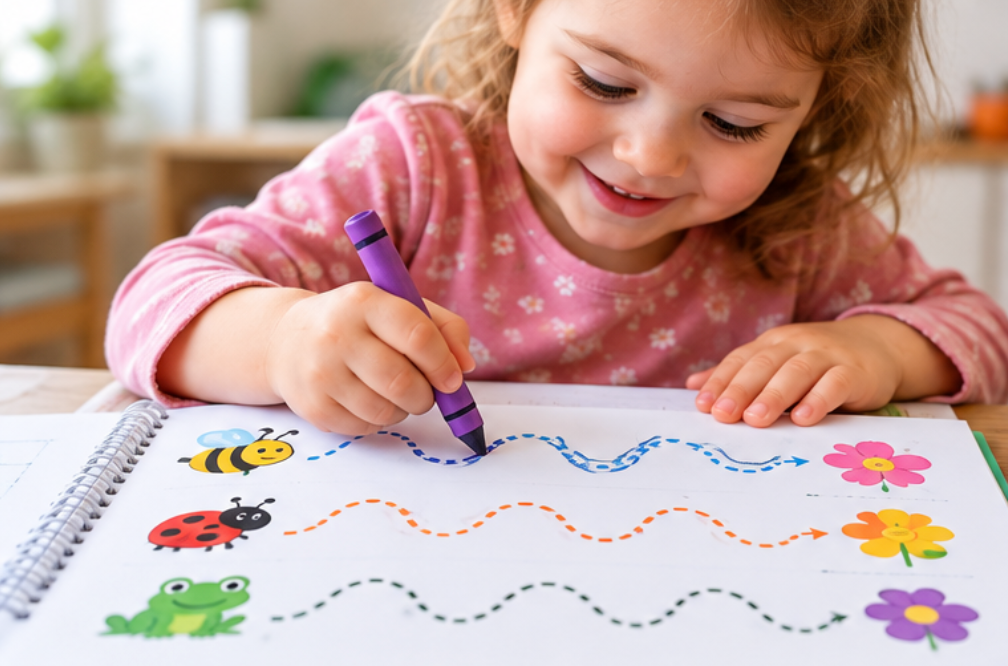
A tracing book should be one tool in the box, not the entire box.
What Can a 3 Year Old Realistically Trace?
This is where expectations matter.
The CDC lists drawing a circle after being shown how as a developmental milestone that most children can do by age three. It also identifies stringing items such as large beads or macaroni as a movement and physical development milestone.
CDC Developmental Milestones for 3 Year Olds
Notice what isn’t on that list.
Writing the alphabet perfectly.
At this age, I’d start simple and gradually increase the challenge.
| Start Here | Try Next | Save for Later |
|---|---|---|
| Straight lines | Zigzag lines | Small detailed paths |
| Horizontal lines | Waves | Complex mazes |
| Vertical lines | Large circles | Repeated small shapes |
| Wide curved lines | Squares | Full alphabet pages |
| Simple paths | Triangles | Small lowercase letters |
| Large shapes | Simple pictures | Neat word copying |
A child doesn’t need to master one column before touching the next.
Use the table as a rough progression rather than a test.
If your child wants to try tracing the first letter of their name, great.
Let them try.
What to Look for in a Good Tracing Book
More pages don’t automatically make a better book.
For a three-year-old, simplicity is often more useful.
Look for thick tracing lines that are easy to see and follow.
Pictures and shapes should be large enough that small mistakes don’t immediately take the pencil completely off course.
There should also be plenty of empty space.
A page containing fifteen tiny activities might look like better value to an adult, but it can be overwhelming to a child who is still learning how to control a crayon.
Good beginner books often include
- Large tracing paths
- Thick lines
- Simple shapes
- Familiar pictures
- Short activities
- Gradually increasing difficulty
- Coloring opportunities
- Simple mazes
- Reusable pages when appropriate
Most importantly, look at the first few pages.
If page one already expects a child to carefully trace uppercase and lowercase letters on narrow lines, it probably isn’t the best starting point for a complete beginner.
The Best Types of Tracing Books for Age 3
Not all tracing books teach the same thing.
The right choice depends on what your child can already do.
Line Tracing Books
These are where I would start with a beginner.
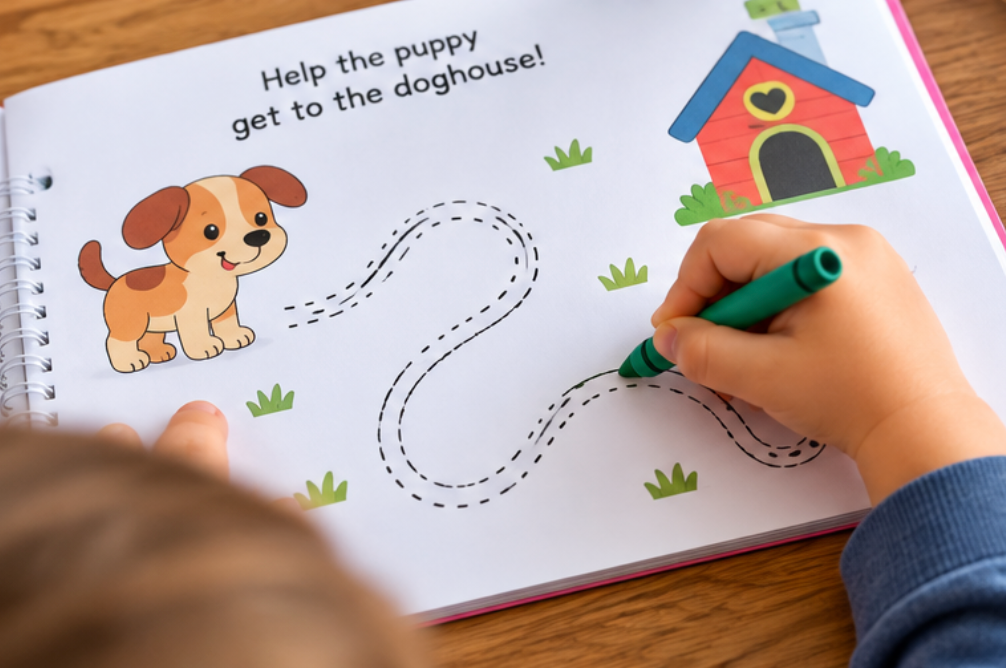
A child might help a puppy reach its bowl by tracing a straight line or follow a winding road from a car to a house.
The destination gives the line a purpose.
That tiny change can make tracing feel much more like a game.
Shape Tracing Books
Once straight and curved lines become easier, introduce larger circles, squares and triangles.
Don’t worry about perfect corners or perfectly round circles.
You’re looking for increasing control.
Picture Tracing Books
These combine pencil practice with something recognizable.
A child might trace a balloon, fish, flower or dinosaur and then color the picture.
That gives them something to do with the page after the tracing part is finished.
Pre Writing Workbooks
These books concentrate on the strokes and patterns children eventually use when forming letters.
You’ll commonly see
- Straight lines
- Curves
- Loops
- Waves
- Diagonal lines
- Zigzags
- Simple patterns
For many three-year-olds, this is far more appropriate than jumping directly into handwriting worksheets.
Letter Tracing Books
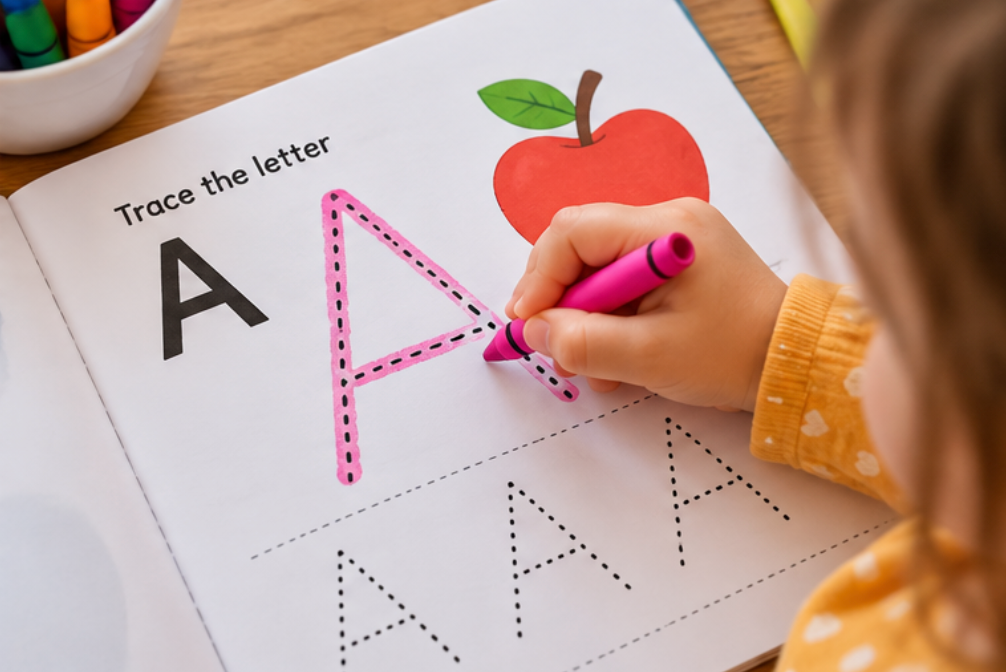
Letters can certainly be introduced at three, especially when a child shows interest.
Their own name is often a natural place to begin.
NAEYC notes that names are meaningful to preschoolers and that children are often particularly interested in learning the letters in their own names.
NAEYC Guide to Promoting Preschoolers’ Emergent Writing
You don’t need to turn that interest into handwriting drills.
Trace one big letter.
Color it.
Find the same letter somewhere else.
Then go play.
Number Tracing Books
Treat numbers much like letters.
Introduce them gradually.
Large numbers with obvious starting points are easier than pages filled with tiny repeated numbers.
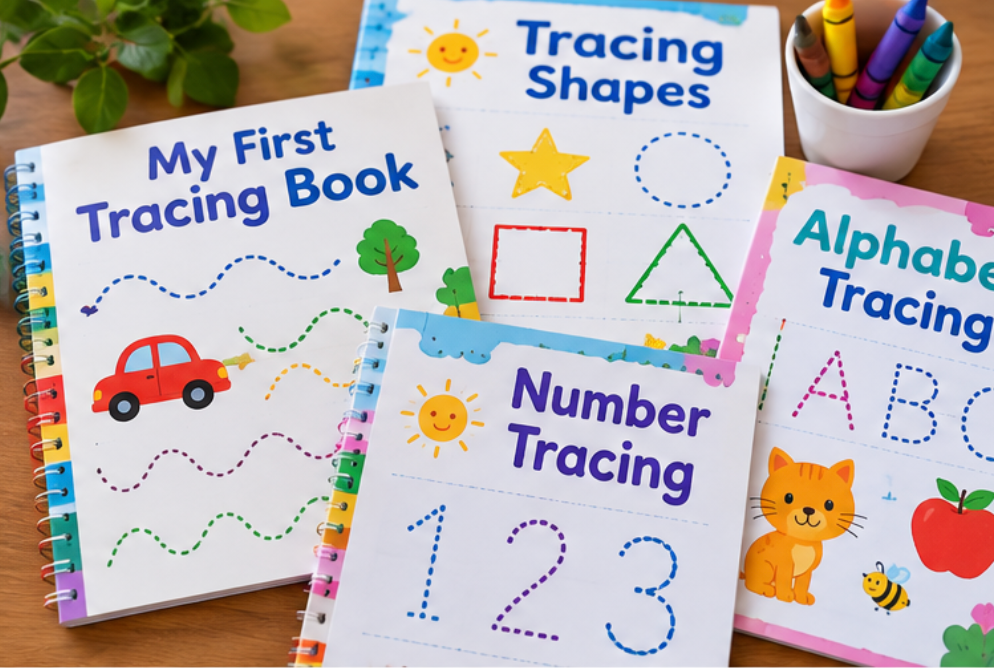
Wipe Clean Tracing Books
These can be useful because children can repeat favorite activities without using a new worksheet every time.
They also make mistakes feel fairly unimportant.
Didn’t follow the line?
Wipe it clean and try again.
Or don’t.
Three-year-olds have plenty of tomorrow left.
Try These 7 Tracing Activities Before Letters
You don’t actually need letters to practice the movements involved in writing.
Turn the lines themselves into little games.
Help the Bee Find the Flower
Draw a flower on one side of the page and a bee on the other.
Connect them with a dotted straight line.
Your child traces the path.
Trace the Falling Rain
Draw a cloud near the top of the page.
Add several dotted vertical lines underneath.
Your child traces the rain toward the ground.
Drive the Car Home
Create two wide parallel lines forming a simple road.
Let your child draw or trace through the middle.
Going slightly off the road is not a traffic violation.
Make Ocean Waves
Draw several large dotted waves across the page.
Your child follows the curves.
Trace Around Shapes
Use large circles, squares and triangles.
Let your child trace around the outline rather than following a complicated dotted path inside it.
Match the Animals
Put matching animals or objects on opposite sides of a page.
Your child draws or traces a line between the pairs.
Follow the Racetrack
Create a large looping path.
A toy car can follow it first.
Then try it with a crayon.
Now pencil control has become play.
Why Lines Can Come Before Letters
Letters are really combinations of movements.
A capital L uses straight strokes.
An O requires a controlled circular movement.
A V introduces diagonal lines.
A C requires a curved movement that stops before becoming a complete circle.
Practicing these basic movements gives children experience controlling direction before they’re also expected to remember what a particular letter looks like.
Think of it as separating two jobs.
First, learn to control the tool.
Then gradually add the symbols.
How to Introduce a Tracing Book Without Making It Feel Like School
Put the book down and let your child choose a page.
That simple choice can change the whole activity.
If they want the dinosaur instead of the page you planned, do the dinosaur.
Start with one or two activities.
Sit nearby and participate instead of hovering over the pencil.
And try not to correct every wobble.
A line that wanders outside the dots isn’t a failed attempt.
The child still picked up the writing tool, followed a direction and tried to control their movement.
That is the practice.
Five interested minutes can accomplish more than twenty minutes of convincing a bored preschooler to finish another page.
What If My 3 Year Old Can’t Trace Yet?
Put the workbook away for a while.
There is no prize for finishing it early.
Children develop fine motor control at different rates, and tracing is only one way to strengthen those skills.
Try activities such as
- Playdough
- Finger painting
- Large chalk drawings
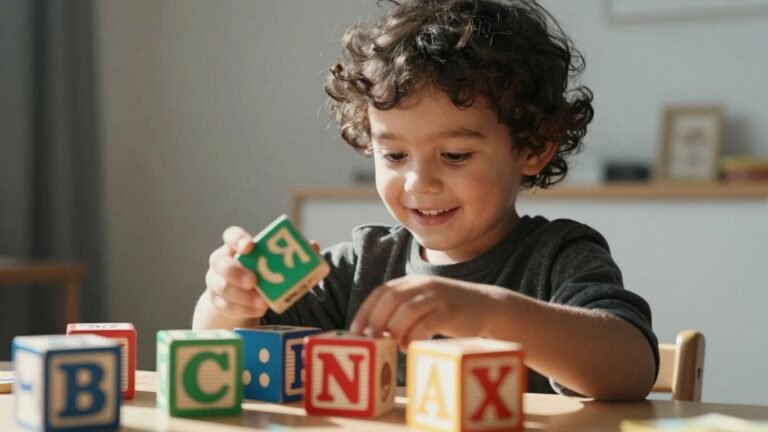
- Building blocks
- Stickers
- Pegboards
- Large beads
- Simple puzzles
- Drawing in sand
- Coloring with crayons
The CDC specifically suggests giving three-year-olds paper, crayons and coloring books for drawing lines and shapes. It also recommends playdough activities such as squishing, pressing, pinching and rolling because they help develop hand and finger muscles used for tasks including writing.
Try the tracing book again another day.
You may be surprised by the difference a few weeks can make.
Don’t Obsess Over Pencil Grip
Parents often notice pencil grip because it’s easy to see.
Then comes the temptation to reposition those little fingers every thirty seconds.
You don’t need to chase perfection.
At three, hand control is still developing. Give your child opportunities to use crayons, chalk, markers and other writing tools rather than turning every drawing session into a pencil-grip lesson.
Short crayons can also encourage children to use their fingers rather than wrapping their entire fist around a long crayon.
Comfort matters too.
A child who is twisting awkwardly in a chair or reaching across a table isn’t in a great position to control a pencil.
Get the basics right.
Feet supported when possible. Paper within easy reach. Plenty of room to move the arm and hand.
Then let them experiment.
Tracing Books or Printable Tracing Pages
You don’t necessarily have to choose.
They serve slightly different purposes.
| Tracing Books | Printable Pages |
|---|---|
| Ready whenever you need them | Print exactly what you want |
| Usually follow a progression | Easy to match current interests |
| Convenient for travel | Repeat favorite activities |
| No printer required | Useful for quick practice |
| Everything stays together | Easy to change difficulty |
| Can include wipe-clean pages | Great for seasonal activities |
A book is convenient when you want an activity ready to go.
Printables are useful when your child suddenly develops an intense fascination with dinosaurs, trucks, ladybugs or anything else that can make pencil practice more interesting.
Use whichever keeps the activity enjoyable.
A Simple 7 Day Tracing Plan
This isn’t a curriculum.
It’s simply an easy way to introduce different movements without overwhelming a beginner.
Day 1
Straight horizontal and vertical lines
Day 2
Large curved lines
Day 3
Zigzags and gentle waves
Day 4
Circles
Day 5
Squares and simple shapes
Day 6
Easy picture tracing or paths
Day 7
Let your child choose their favorite activities again
Keep each session short.
Five minutes may be plenty.
If your child happily continues, let them continue.
If they’re finished after two minutes, that’s information too.
Common Tracing Mistakes Parents Can Avoid
One of the biggest mistakes is starting with material that’s too difficult.
A child who struggles through page after page of tiny letters isn’t necessarily learning more than the child happily drawing giant circles.
Avoid
- Starting with complicated alphabet pages
- Expecting perfect lines
- Correcting every mistake
- Making children finish a page
- Using visually crowded worksheets
- Making sessions too long
- Comparing one child with another
- Treating tracing like homework
There is also no need to rush children out of scribbling and drawing.
NAEYC describes children’s early writing as beginning with scribbles and developing into letter-like shapes and eventually recognizable letters. It encourages adults to support experimentation rather than worrying about neatly formed letters during the preschool years.
Those random-looking marks aren’t necessarily something you need to get past.
They’re part of learning.
When Should You Move From Tracing to Writing?
There doesn’t need to be an official graduation day.
The two activities can overlap.
Watch for signs that your child is gaining more control.
They may begin
- Copying simple shapes
- Drawing recognizable circles
- Following paths more easily
- Showing interest in letters
- Asking how to write their name
- Making deliberate marks rather than only scribbling
- Copying lines and simple patterns
If they start asking you to write their name, use that interest.
Write it in large letters.
Let them trace it.
Then let them try underneath.
Their version may look nothing like yours.
Keep it anyway.
Frequently Asked Questions
Should a 3 Year Old Be Able to Trace Letters?
Not necessarily.
Some three-year-olds will be interested and capable of tracing simple letters. Others are still developing the hand control needed for lines and shapes.
The CDC’s three-year milestone guidance includes copying a circle after being shown rather than expecting children to write letters.
What Should a 3 Year Old Trace First?
Start with large straight lines and simple paths.
Then introduce curves, zigzags, circles and basic shapes.
Letters can follow as control improves.
How Long Should a 3 Year Old Practice Tracing?
There isn’t a magic number.
For many young children, a few focused minutes is plenty.
Watch the child rather than the clock.
If tracing turns into frustration, stop.
Are Tracing Books Good for Fine Motor Skills?
Tracing gives children opportunities to practice controlled movements with writing tools, but it shouldn’t be the only fine motor activity they do.
Drawing, playdough, building, stringing, painting and manipulating small objects all give hands different kinds of practice.
Should I Correct My Child’s Pencil Grip?
You can model a comfortable grip and provide suitable writing tools, but avoid turning every activity into constant correction.
At this age, children are still developing hand and finger control.
Are Wipe Clean Tracing Books Better?
Not necessarily better, but they’re useful.
Children can repeat the same activity several times, and mistakes disappear with a wipe.
Paper books have advantages too, particularly when children want to color or keep their work.
What If My Child Refuses to Trace?
Don’t force it.
Try drawing, chalk, painting, playdough or another hands-on activity instead.
Bring tracing back later in a more playful form.
Should Children Trace Uppercase or Lowercase Letters First?
You don’t need to race through either alphabet at three.
Start with letters that are meaningful to the child, particularly letters in their name, and keep the activities simple.
Make Tracing Something They Want to Do
The best tracing books for 3 year olds aren’t necessarily the ones with 200 pages, the entire alphabet and a giant list of promised educational benefits on the cover.
They’re the ones that meet children where they are.
For one child, that might mean tracing a big circle.
For another, it might be helping a cartoon puppy follow a winding path.
And another may already be desperate to trace the first letter of their name.
Follow that interest.
At three, the goal isn’t beautiful handwriting.
It’s helping children become comfortable making marks, controlling a writing tool and discovering that what they put on paper can actually mean something.
If they close the book wanting to come back another day, you’re doing just fine.


Ms. Kerri’s Corner provides a exciting virtual space for preschool learning. Through a variety of engaging activities, she exposes young minds to early math, literacy, science and social-emotional skills in a developmentally appropriate way. Centers for blocks, art, books and music allow children to explore hands-on learning at their own pace. Guided lessons subtly introduce number sense, letter sounds and narrative thinking. Careful observation gives insight into each child’s progress across domains. Viewers are also invited to participate, reinforcing that their ideas are valued. By making learning fun yet purposeful, Ms. Kerri lays the groundwork for future academic success while fostering creativity and imagination. Her program offers preschoolers valuable screen-based learning experiences.