Fine Motor Games for Preschoolers Learning Through Play That Actually Works
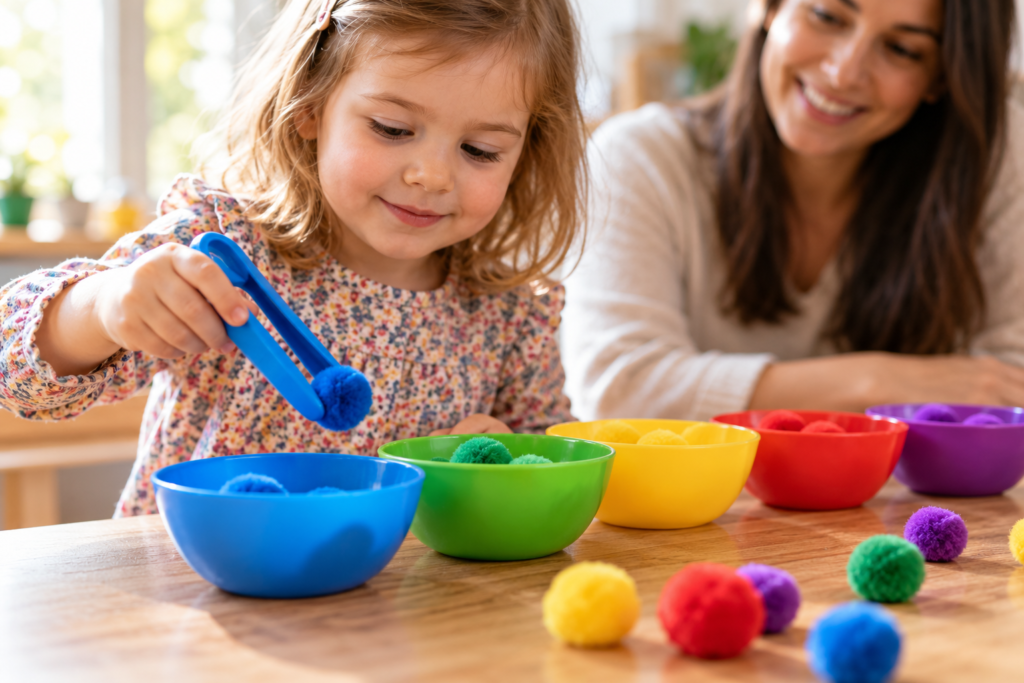
Hand a preschooler a pair of tongs and a bowl of pom-poms, and you might get a sorting game. You might also get a pretend restaurant where every customer orders something purple. Either way, those little hands have a job to do.
That is the appeal of fine motor play. Children get to squeeze, build, scoop, and experiment while working toward something they care about. They aren’t thinking about finger control when they carefully place a roof on a block house. They just want the house to stay standing.
The best fine motor games for preschoolers are simple enough to start quickly and flexible enough to follow a child’s imagination. Here are ten activities that turn everyday materials into worthwhile play.
What Are Fine Motor Skills?
Fine motor skills involve the small movements of the hands and fingers. Children use them when turning pages, pulling up a zipper, holding a crayon, or opening a snack container.
Watch a child peel a sticker. One hand holds the sheet while the other finds an edge, lifts it, and pulls. Then comes the careful business of placing it somewhere important—possibly right in the middle of your shirt.
Games offer opportunities to practice these movements. The aim is to give children interesting things to do with their hands, with enough challenge to keep them curious.
1. Open a Playdough Pizza Shop
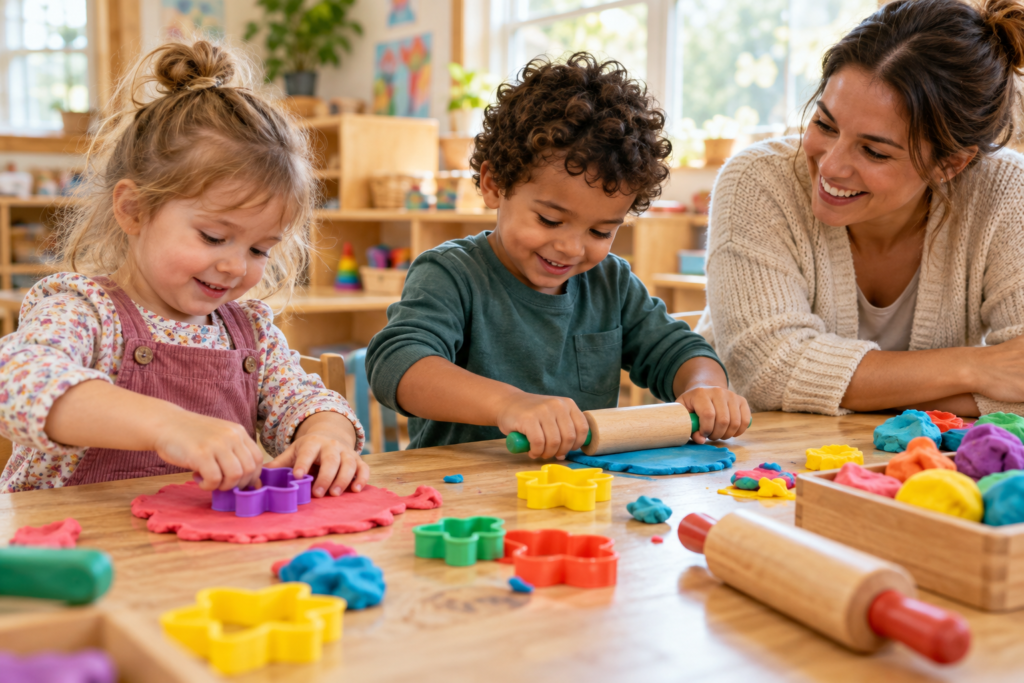
Playdough gives children plenty of ways to use their hands before any tools come out.
You’ll need: Playdough, a washable surface, and optional child-safe dough tools.
Invite your child to make a pizza. They can flatten the base with their palms, roll thin dough “cheese,” and pinch off pieces for toppings.
Become a customer and place an order: “Could I have a small pizza with three mushrooms?” Then let the chef decide what mushrooms look like.
If your child prefers making snakes or squashing everything into a pancake, follow along. Squeezing, rolling, and pinching are all part of the activity.
2. Rescue the Pom-Pom Animals
A little story can make moving objects from one bowl to another surprisingly absorbing.
You’ll need: Large pom-poms, easy-squeeze tongs, and two containers.
Explain that the pom-pom animals need help reaching their new home. Your child can pick them up with the tongs and carry them across.
Start with the containers close together. Later, introduce separate homes for different colors or ask your child to rescue one animal at a time.
Check the tongs yourself first. If they take a strong squeeze to open or close, choose an easier pair. The game should offer a manageable challenge.
3. Run a Toy Car Wash
Sometimes the toys already on the floor are the best invitation to play.
You’ll need: Washable toy cars, a shallow bowl of water, a small sponge, a soft brush, and a towel.
Set up a washing station and let your child scrub the cars, clean around the wheels, and dry each vehicle.
Holding a car with one hand while brushing with the other gives both hands different jobs. Squeezing the sponge adds another movement to explore.
Add a parking area for clean cars or a pretend queue for vehicles waiting their turn. Use toys without batteries, supervise the water, and empty the bowl afterward.
4. Feed the Cardboard Creature
An empty box becomes much more interesting with a hungry face.
You’ll need: A small cardboard box, large paper “food” pieces, and crayons.
Prepare a wide mouth opening yourself and cover any rough edges. Let your child decorate the creature, then offer paper food to push through the opening.
Give it a personality. Perhaps it only eats blue food today, or it wants three paper carrots before dessert.
Your child can tear the food pieces, pick them up, and post them through the mouth. Make the opening generous at first so the game feels achievable.
5. Build a Sticker Scene
Stickers combine a small hand challenge with the satisfaction of making a picture.
You’ll need: Large stickers, paper, and markers.
Draw a simple setting: an empty garden, a road, or an underwater scene. Your child can peel and place stickers to fill it.
If lifting the edges is difficult, remove the surrounding backing or loosen a corner. Offer help with the tricky part, then let your child finish.
Leave room for their ideas. A dinosaur floating above the garden might be exactly what the picture needs.
6. Deliver the Clothespin Laundry
Preschoolers often enjoy doing a miniature version of a familiar household job.
You’ll need: Easy-squeeze clothespins, small fabric squares, and the edge of a sturdy open box.
Pretend the fabric pieces are clothes that need hanging up. Show your child how to squeeze a clothespin, position the fabric against the box edge, and release.
Start with a few pieces. If managing the fabric and clip together is difficult, hold the fabric steady.
Taking everything down is another round of play. Your child can collect the “laundry,” sort it, and deliver it to a basket.
7. Make Paper Soup
Tearing paper can be just as appealing as cutting it, especially when there is something to make afterward.
You’ll need: Scrap paper, a bowl, and a large spoon.
Invite your child to cook pretend soup by tearing paper into ingredients. Green strips might become cabbage, while orange pieces become carrots.
Demonstrate how to hold the paper with both hands and pull in opposite directions. Make a small starter tear if needed.
Then stir, serve, and take orders. Paper soup can become a restaurant game, a picnic, or dinner for a roomful of stuffed animals.
8. Build a Bridge for a Favorite Toy
A construction challenge gives careful hand movements a clear purpose.
You’ll need: Blocks or age-appropriate connecting pieces and a small toy.
Ask your child to build a bridge the toy can travel across or underneath. Let them choose where to begin.
They may need to line up blocks, connect pieces, or adjust a section that keeps falling. Give them time to experiment before stepping in.
If the first attempt collapses, make a simple observation: “That side tipped when the car went over.” Then see what they try next. Rebuilding is part of the game.
9. Scoop and Serve a Pretend Picnic
Scooping involves more than filling a spoon. Children also have to carry it, aim, and decide when to tip.
You’ll need: A tray, containers, spoons, and a suitable scooping material.
Set up a pretend picnic and invite your child to fill bowls for their toys. Rolled oats can work for children who no longer mouth play materials; a shallow-water version with cups is another option.
Begin with large containers and short distances between them. Smaller bowls can come later if your child wants a challenge.
Expect spills. A tray helps contain them, and a small cloth lets your child join in the cleanup.
10. Create a Treasure Trail
Drawing can become part of an adventure instead of a task to complete.
You’ll need: Paper, crayons, and a favorite toy to hide.
Hide the toy somewhere nearby, then make a simple map together. Draw a path past recognizable landmarks, such as the sofa or a bookshelf.
Let your child add circles, lines, crosses, and any details they consider essential. Follow the map together to find the treasure.
Then swap roles. Your child can hide the toy and create directions for you. The marks have a purpose, even if you need the mapmaker to explain them.
What Makes These Games Work?
A useful game gives a child something they want to accomplish. Feed the creature. Finish the bridge. Find the treasure. The hand practice happens along the way.
Keep the challenge adjustable. Offer larger pieces, softer dough, or tools that need less pressure when frustration builds. When something becomes easy, let your child suggest what happens next.
Repetition is welcome, too. If the pizza shop opens every afternoon, there is no need to replace it with a new activity. Familiar games give children space to try different approaches.
Supervise water, scissors, cords, and small materials closely. Choose larger alternatives for children who still put objects in their mouths.
Most of all, leave some room for play to wander. The treasure map may become a birthday card, and the car wash may start washing plastic dinosaurs. When children have a reason to keep exploring, their hands have plenty to do.

Ms. Kerri’s Corner provides a exciting virtual space for preschool learning. Through a variety of engaging activities, she exposes young minds to early math, literacy, science and social-emotional skills in a developmentally appropriate way. Centers for blocks, art, books and music allow children to explore hands-on learning at their own pace. Guided lessons subtly introduce number sense, letter sounds and narrative thinking. Careful observation gives insight into each child’s progress across domains. Viewers are also invited to participate, reinforcing that their ideas are valued. By making learning fun yet purposeful, Ms. Kerri lays the groundwork for future academic success while fostering creativity and imagination. Her program offers preschoolers valuable screen-based learning experiences.